Explainer
Are slot spins independent? How randomness works
The short answer
For independent events, learning a previous result does not change the probability of the next event. This is a property of a model, not a conclusion that can be established from a short streak.
In this article
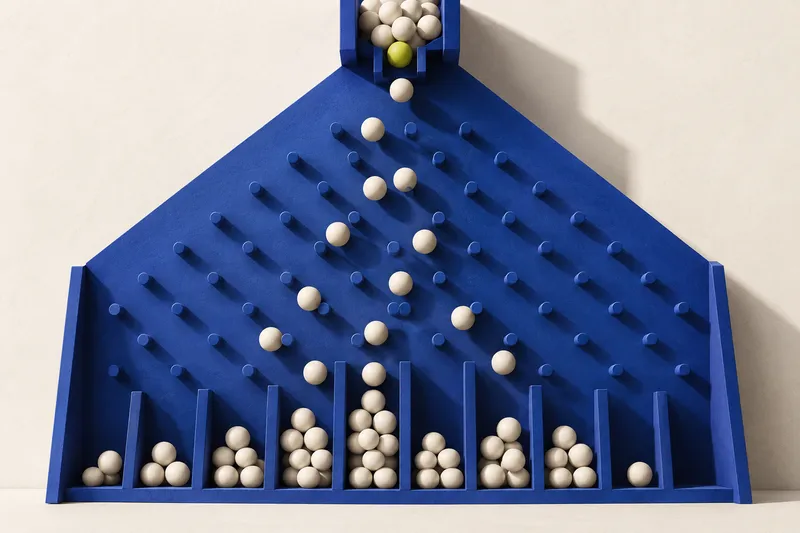
A run of similar outcomes makes people look for a correction. The mathematical question is narrower: does knowledge of an earlier event change the probability assigned to a later one? If it does not, the events are independent. The length of a streak does not, by itself, answer that question.
Separate the sequence from the next event
Consider a hypothetical device with two equally likely outputs, A and B, on each independent use. The probability of four specified A outputs is 1/2 × 1/2 × 1/2 × 1/2, or 1/16. Once those four outputs have already occurred, the probability of A on the next use is still 1/2. The first number describes an entire sequence in advance; the second describes the next event given a known history.
Illustrative example
| Question | Probability in this model |
|---|---|
| Will the next four outputs all be A? | 1/16 |
| After four As, will the next output be A? | 1/2 |
| After four As, will the next output be B? | 1/2 |
Independence is an assumption to establish
OpenStax defines independence through conditional probability. The definition cannot be verified merely by watching a handful of results. Systems can contain persistent state, changing conditions, or rules that make one event depend on another.
For example, selecting an item from a container and leaving it out changes the remaining contents. Returning the item and restoring the same selection conditions gives a different experiment. A description that calls both processes “random” has not told you whether their successive results are independent.
How to read a claim about a streak
Ask whether the claim concerns a complete sequence before it happened or one event after a known history. Then ask which assumptions justify the calculation. A screenshot of a streak supplies observations, but not the full probability model, software state, or evidence needed to test those assumptions.