Explainer
Finn and the Swirly Spin: How the Spiral Grid Moves
The short answer
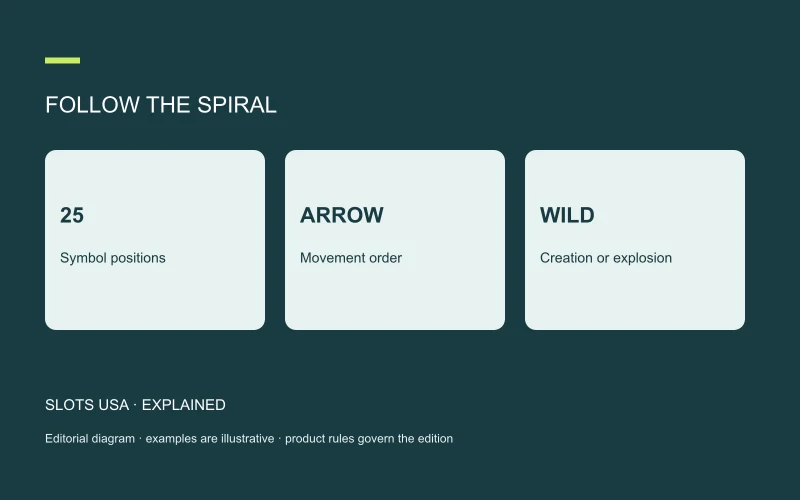
Finn and the Swirly Spin uses a 25-position spiral instead of conventional reels. When symbols are removed, other symbols follow the arrow into the available positions. Its Avalanche feature also distinguishes wins containing a Wild from wins that create a Wild, giving the spiral a sequence you can follow step by step.
In this article
Finn and the Swirly Spin: following the arrow
The official NetEnt page describes 25 independent symbol positions and movement from higher-numbered spaces toward lower-numbered spaces. The arrow provides the route. That makes the position order more useful than assuming everything simply falls vertically.
To follow a demonstration, draw a five-by-five grid and trace the visible arrow. Pick one surviving symbol and watch where it moves after a removal. This is an observation exercise for understanding the interface: the current game state determines the movement shown.
Wild creation and Wild explosions
NetEnt describes two outcomes for a winning combination. A win without a Wild creates one; when a contributing Wild is part of a win, it explodes and removes adjacent symbols vertically and horizontally. The resulting spaces allow the sequence to develop further.
The distinction is easiest to record with three columns: winning positions, Wild involvement and positions cleared. It tells you why a particular screen changes. The amount the game pays belongs in a fourth column so that an explanation of movement stays separate from an explanation of award value.
| Question | Where to look |
|---|---|
| Which way do symbols travel? | Spiral arrow and position sequence |
| Why was a Wild created? | The winning combination that preceded it |
| Which spaces were cleared? | The Wild’s neighboring positions |
| What settled? | Labeled round-award counter |
The four random-feature names
The product page lists Starfall Wilds, Dragon Destroy, Irish Luck and Magic Transform. Those names identify additional modifiers. When one appears, read its label before trying to explain the next grid change; it may add an action beyond the ordinary win-and-move sequence.
For a useful set of notes, record the feature name once beside the round identifier. You can then describe the visible grid changes in order. That is more informative than giving each visual effect a new informal name, particularly when comparing your notes with the official help.
A worked accounting example
Suppose a hypothetical paid round costs $0.25 and its full sequence credits $2.50. The award is ten times the wager, and the net change for that round is $2.25. If the spiral moved several times, those movements describe stages within the record whose final award you just calculated.
The example illustrates how to report the final amount consistently. It does not establish a typical award, feature frequency or expected result. For the actual edition, use its own round history and rule labels.
Quick questions
Is the spiral just a different animation for vertical falling reels? Its documented movement follows the numbered spiral route. Where can I learn the vocabulary? Cascading game structures introduces special symbols, while random-number generation explains how game outcomes and their presentation fit into a round.