Explainer
Butterfly Staxx: Re-Spins vs Butterfly Spins Explained
The short answer
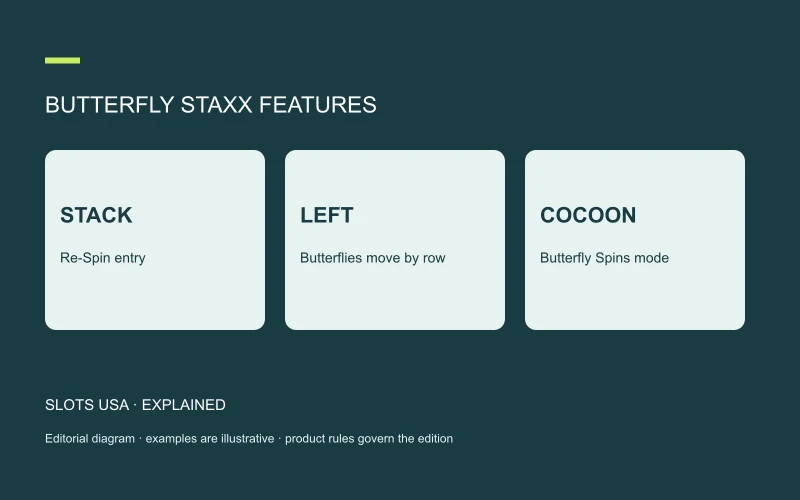
Butterfly Staxx has two separate features: Re-Spins triggered by a full reel stack of butterflies, and Butterfly Spins triggered by three or more scatters. During Re-Spins, visible butterflies move toward the left side of their row and remain for the sequence. Butterfly Spins introduce cocoon symbols instead.
In this article
Butterfly Staxx Re-Spins: follow each row
The official feature rules describe a five-reel, four-row layout with 40 lines. After the Re-Spin trigger, butterflies move to the leftmost available position in the same row. Additional visible butterflies can join the retained group and extend the sequence.
The words “same row” make the movement easier to follow. On a four-row sketch, mark each butterfly’s starting row. Then fill the available cells from the left as the animation moves them. That picture explains accumulation across a sequence more clearly than treating each new screen as a fresh arrangement.
A simple position example
Consider an illustrative row with butterflies initially in columns 3 and 5 and empty butterfly positions to their left. Following the documented direction, the row’s retained butterflies accumulate toward its leftmost available positions. The game shows the exact movement and distinguishes visible butterflies from symbols hidden behind an existing butterfly.
This example describes position tracking, rather than a paid combination. To determine an award, read the completed eligible paylines and the settlement amount. Position count and monetary value belong to separate parts of the explanation.
Butterfly Spins and cocoons
The provider identifies Butterfly Spins as a different feature, with cocoons that can be dormant or active; visible active cocoons become butterflies. It also states that Butterfly Spins and Re-Spins cannot activate simultaneously.
That gives you a quick identification test: read the feature label, then look at the symbol family on the screen. A retained butterfly sequence and a cocoon-based feature may share a theme, while using different steps and counters.
| Feature | Entry or visual cue | Useful observation |
|---|---|---|
| Re-Spins | Full butterfly stack | Leftward movement within each row |
| Butterfly Spins | Three or more scatters | Cocoon states and transformations |
| Ordinary reel win | Paid line route | Award shown before the next feature stage |
Reading the credited total
NetEnt describes settlement of initial line wins before Re-Spins begin, followed by the feature’s result. Watch whether a counter shows a component or the cumulative total. That label determines whether two visible amounts should be added.
Illustrative example: if separately identified components are $0.60 from the initial screen and $2.40 from the feature, their combined award is $3. With a $0.50 starting wager, that is six times the wager. If the final screen already labels $3 as the combined total, it already includes both components.
Quick questions
Does every butterfly on an image extend the sequence? The rules specifically refer to visible butterflies and their placement. Is a Re-Spin counter a free-spin allocation? Read the feature label: the two named features have distinct entry and development rules.
For related reading, free spins versus respins introduces special symbols, and slot award versus net result explains the accounting units used above.